|
|
|
|
|
|
|
|

|
Don't Miss Any Special Deals - Sign Up To Our Newsletter!
| ||||||||||||||
| CLICK HERE FOR A FULL LIST OF ALL ANTHONY SAUNDERS PRINTS BY TITLE |
|
Anthony Saunders  Postcards Postcards |
[UP] - Royal Navy Battleships - Royal Navy - US Aircraft Carriers - US Battleships - German Navy - German U-Boats - Royal Air Force - Battle of Britain - US Air Force - Japanese Navy - Print List - New Releases - Aircraft Directory - Falklands War - Postcards |
| Navigation | |
| Page 1 of 3 | Page 1 .. Next |
|
|
|
|
|
|
|
|
|
|
|
|
|
|
|
|
|
|
|
|
|
| Text for the above items : |
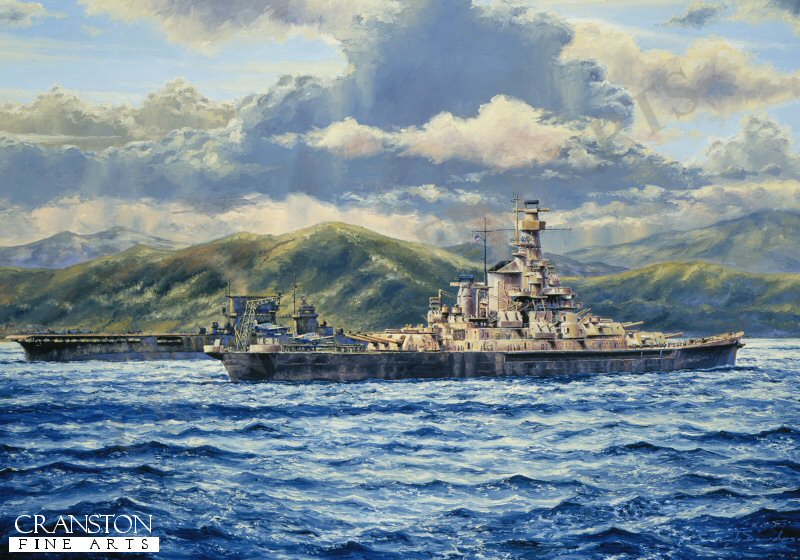
USS Indiana, First Tour of Duty by Anthony Saunders. (PC) To increase the strength of the US fleet in the Pacific during the critical early months of the war, USS Indiana went through the Panama Canal. On the 28th of November 1942 USS Indiana joined Rear Admiral Lee's aircraft carrier screening force. For the next 11 months, USS Indiana helped protect USS Enterprise and USS Saratoga, which had been supporting the US invasion on the Solomon Islands. On the 21st of October 1943 USS Indiana went to Pearl Harbor, but after only a couple of weeks left to support forces designated for the invasion of the Gilbert Islands. The battleship protected the carriers which supported the Marines during the bloody fight for Tarawa atoll. Then, in late January 1944, she bombarded Kwajalein for eight days prior to the Marshall Island landings on 1st February 1944. USS Indiana collided with the battleship USS Washington while refuelling destroyers, killing several men. Temporary repairs to her starboard side were made at Majuro and USS Indiana returned to Pearl Harbor on 13th February 1944 for additional repair work. The painting shows USS Indiana with one of the two carriers she protected. |
Okinawa Landing - USS Colorado by Anthony Saunders. (PC) The USS Colorado holds the all time record of 37 consecutive days of firing at an enemy and the record of 24 direct enemy air attacks in 62 days both while at Okinawa. |
Operation Drumbeat by Anthony Saunders (PC) The entry of the United States into the war opened up vast new hunting grounds for the German u-boat fleet. Operation Paukenschlag (Drumbeat in English) began in January 1942, bringing the U-boats their easiest pickings of the war. Over 300 allied vessels were sunk during the Paukenschlag along the US coastline, ranging from New York harbor, to the Straits of Florida. This period, also known as the second Happy Times to the men of the U-boats, was only brought to an end in mid 1942 by the formation of allied convoy systems. On the evening of April 5th 1942, U552, commanded by Kapitanleutnant Erich Topp, sealed the fate of the British tanker MV British Splendour east of Cape Hatteras. The U-boat was part of the fourth wave of boats of Operation Paukenschlag, she returned to Saint Nazaire on April 27th 1942 having sunk seven ships during the patrol. |
Pearl Harbor, USS California, by Anthony Saunders. (PC) At dawn on the 7th December 1941, 350 Japanese warplanes flew from their carriers and attacked the US pacific fleet at Pearl harbor, on the Hawaiian island of Oahu. the attack concentrated on Battleship Row which included USS California (Left) and USS Nevada (Right) which was the only battleship to get underway during the attack. However coming under intense bomb attack she was later beached. For the Japanese the success was not total, as the US carrier fleet was out on manoeuvres on the day of the attack. |
HMS Invincible - The Dawn of Jutland by Anthony Saunders. (PC) The Battle of Jutland took place on 31st May 1916. It was the largest clash of battleships in history, over 250 ships from the Grand Fleet and the German High Sea Fleet took part. But both fleets struggled to gain supremacy in difficult conditions. The battle started well for HMS Invincible, together with Inflexible and Indomitable she formed part of the 3rd Battlecruiser Squadron under Admiral Hood. She scored eight direct hits on Lutzow which caused the German ship to withdraw from the battle and eventually sink. HMS Invincibles luck finally ran out when she was hit on the midships Q turret, the eventual explosion causing the ship to sink in two halves. Here Invincible is seen prior to the battle from HMS Nestor, one of the destroyer escorts of the 13th Flotilla. |
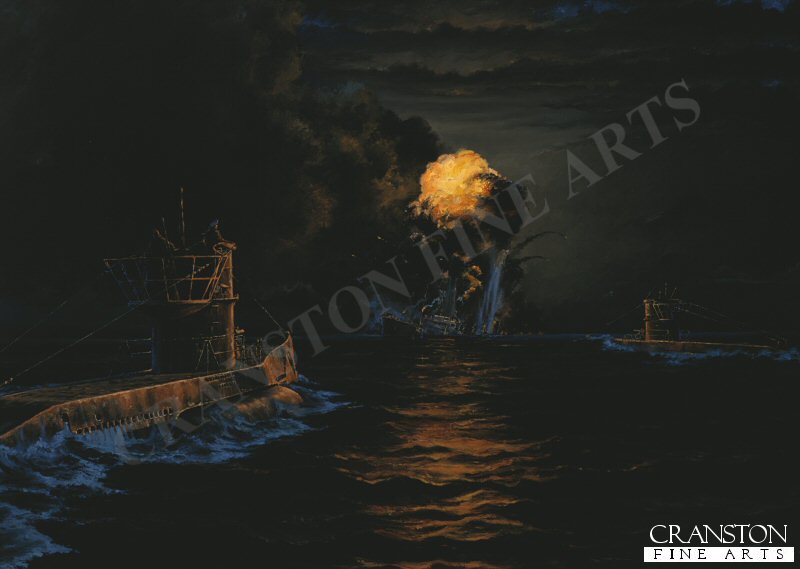
U-203 Under Cover of Darkness by Anthony Saunders. (PC) October 1941, U203 approaches her mooring on the western bank at the French port of Brest. Her fate would be sealed by depth charges from the destroyer HMS Pathfinder and aircraft from the escort carrier HMS Biter while attacking the convoy ONS 4 south of Greenland on April 25th 1943. |
SMS Lutzow at the Opening of the Battle of Jutland by Anthony Saunders. (PC) Admiral Hippers flagship SMS Lutzow followed by Derfflinger and Seydlitz. Also seen in the painting are Moltke and Von der Tann. |
USS North Carolina ,Saipan Bound by Anthony Saunders. (PC) By June 1944 the US Fleet had made a huge leap across the Pacific to the Marianas, a small group of Japanese held islands of which Saipan would prove the most difficult to overcome. The landing were supported by the US 5th Fleet, which included USS North Carolina together with an increasingly powerful armada of battle hardened warships. |
Nelsons Victory at Trafalgar by Anthony Saunders. (PC) Undoubtedly the most famous and decisive battle in the history of naval warfare. The battle of Trafalgar was fought on a calm, almost windless day, on 21st October 1805. Nelsons revolutionary battle plan was to cut apart the larger Franco-Spanish fleet of Vice-Admiral Villeneuve by sailing in two single column divisions directly at right angles into the combined fleet and thus rendering almost half of the leading ships useless until they could turn and join the fight, which in such calm conditions could take hours. The battle raged for five hours in which time not one British ship was lost, however, Nelson would tragically lose his life at the very moment of his triumph, a triumph which rendered the British Navy unchallenged in supremacy for over a century. Here, Nelsons flagship, HMS Victory, followed by HMS Temeraire is seen breaking the Franco-Spanish line and commencing her murderous hail of gun fire into the stern of Villeneuves flagship, Bucentaure. Meanwhile the Victory herself is being fired upon by the French Neptune. Redoutable can be seen at the far right. |
HMS Ramillies and HMS Warspite at Normandy by Anthony Saunders. (PC) HMS Ramillies and Warspite manoeuvre into position off the coast of Normandy. The major battleships of the Home Fleet, with their massive guns which could deliver gunfire with pinpoint accuracy to 17 miles. they proved invaluable on the day of the biggest seaborne land invasion in history. |
Boiling Point - USS Missouri by Anthony Saunders. (PC) Launched on the 29th of January 1944, USS Missouri was the last and one of the finest battleships of any fleet. With a top speed of 33 knots, she earnt the name Fast Battleship, as the Iowa class to which she belonged were known. Bristling with an assortment of anti-aircraft, Missouri was as much a floating anti-aircraft battery as a battleship. With these qualities Missouri was well equiped to counter the desperate aerial attacks faced when she joined the Pacific Fleet. Here Missouri is seen repelling a kamikaze attack on the 11th of April 1945, with the destroyers Melvin (left) and McCord. Although one of the kamikazes did get through the curtain of shell fire, little damage was sustained. |
The Final Salvo - HMS Hood by Anthony Saunders. (PC) HMS Hood readies to fire off a what proved to be the final salvo against the Bismarck before a shell from the German battleship penetrated the magazine of HMS Hood, tearing apart the British ship in an enormous explosion. |
Battle of Tsushima by Anthony Saunders (PC) Japanese Torpedo destroyers, rush in to finish off the Russian battleships near the end of the Battle of Tsushima. |
Dawn Enterprise by Anthony Saunders. (PC) The first light of dawn silhouettes the massive outline of the Yorktown class carrier USS Enterprise, in mid April 1944 she was partnered by the new Essex Class carrier USS Lexington. |
USS Iowa leaving New York by Anthony Saunders. (PC) BB61 Iowa, was commissioned in February 1943 at the New York Navy yard. her first mission was to the North Atlantic in August 1943 to neutralise the threat of the German Battleship Tirpitz. By early 1944 she joined the Pacific fleet taking part in many of the major battles including Saipan, Leyte Gulf and Okinawa. She was re-commissioned in 1951 for the Korean war and again in April 1984. |
Wolves at Saint Nazaire by Anthony Saunders (PC) Portrayed in the southern lock at the French port of Saint Nazaire during the Autumn of 1941 are from left: U552, commanded by Kapitanleutnant Erich Topp, U567, commanded by Oberleutnant zur See Engelbert Endrass and U93, commanded by Oberleutnant zur See Horst Elfe. Saint Nazaire was home for two U-boat flotillas: 7. U-Flotille, the Wegener Flotilla and 6.U-Flotille, the Hundius Flotilla. It produced some of the top U-boat commanders including Topp, Endrass, Prien and Kretschmer. The base reached a peak of activity in mid 1943, however, by the end of the war the entire port had been flattened by the allied air forces. The only buildings to survive the onslaught were the bomb proof U-bunkers which can still be seen to this day |
Bismarck - The Final Voyage by Anthony Saunders. (PC) One of the finest battleships of all time, Bismarck was built by the Blohm and Voss shipyard in Hamburg and launched in February 1939. Her first duty was for commerce raiding in the north Atlantic. Together with the heavy cruiser Prinz Eugen, the destroyers Z10, Z16 and Z23 and a minesweeper. The Bismarck, commanded by Vice Admiral Gunther Lutjens, left her last anchorage at Grimstadt Fjord in Norway. Once Bismarcks departure was confirmed all available British forces were deployed to meet the threat. On the 24th of May 1941 the Bismarck sailed into naval history - sinking the battlescruiser and pride of the British fleet - HMS Hood. But Bismarck would have little time to celebrate, she was sunk by a scorned British fleet three days later. Here Bismarck is depicted on the evening of the 21st May 1941 entering the open sea on her fateful final voyage. |
The Battle of Jutland, HMS Royal Oak by Anthony Saunders. (PC) The Battle of Jutland was fought in the North Sea between the 31st May and the 1st of June 1916. The British Grand Fleet had been virtually unopposed for nearly a century but now there was a challenge to the throne; the German Navy. Although smaller, it had caught up fast and by the time of Jutland, had some telling advantages over the British Fleet. the plan for the battle was to lure the British Grand Fleet into a lethal trap in German waters. In the event although desperately fought by both sides, the battle was a stale mate. the confused conflict was hampered on both sides by bad luck, bad weather and poor communications. at the end of the battle, the Royal navy had suffered higher losses in men and ships, but the German fleet never ventured out of harbour to seek battle again. |
Escort for the Troops - USS New York by Anthony Saunders. (PC) The Atlantic ocean was the lifeline between Britain and America, as well as millions of tons of raw materials, GIs were also transported over in all manor of hastily converted liners. Protecting the troops from marauding u-boats and German surface ships was of paramount importance to the allied fleets. Although USS New York spent a good deal of the war in the Atlantic, she also participated in the Torch landings off North Africa and took part in the Pacific campaign, seeing action at both Iwo Jima and Okinowa. |
The Battle of the Nile by Anthony Saunders. (PC) Lord Horatio Nelson and the British fleet found the French 13 ship of the line fleet anchored at Aboukir Bay. Nelsons plan was to attack the French fleet on their unprotected port side. By the end of the battle nearly all the French ships were sunk or captured. The painting shows HMS Swiftsure in the centre with the burning 124 gun flagship LOrient behind. To the left is the surrendered hulk of the French ship Franklin. |
The Pedestal Convoy - HMS Indomitable by Anthony Saunders. (PC) The Pedestal Convoy, to provide desperately needed supplies to the beleaguered Mediterranean island of Malta in August 1942, was perhaps one of the most famous and strategically important convoys of World War II. It had a powerful escort, including three aircraft carriers, one of which was HMS Indomitable. Closely escorted by the cruiser HMS Sirius, she came under heavy attack from both German and Italian bombers on the 12th of August 1942 and was eventually forced to turn back after bomb damage put her flight deck out of action. |
| Navigation | |
| Page 1 of 3 | Page 1 .. Next |
|
Contact Details |
|
Sign Up To Our Newsletter!
This website is owned by Cranston Fine Arts. Torwood House, Torwoodhill Road, Rhu, Helensburgh, Scotland, G848LE Contact: Tel: (+44) (0) 1436 820269. Email: cranstonorders -at- outlook.com |
 |