|
|
|
|
|
|
|
|

|
Don't Miss Any Special Deals - Sign Up To Our Newsletter!
| ||||||||||||||
| CLICK HERE FOR A FULL LIST OF ALL ANTHONY SAUNDERS PRINTS BY TITLE |
|
Anthony Saunders  Aircraft Directory Aircraft Directory  Hurricane Hurricane |
[UP] - Spitfire - Hurricane - Lancaster - Mosquito - Kittyhawk - Wellington - Sopwith Camel - Mustang - Flying Fortress - Thunderbolt - Me109 - He111 |
| Hurricane Aviation Prints by Anthony Saunders Aviation Prints |
|
|
|
| Text for the above items : |
Fear Nothing by Anthony Saunders. The Battle of Britian - 28th August 1940. The Battle of Britain is at its height but the threat of invasion is still a deadly reality. As the country waited, grim and expectant, for Hitlers Operation Sealion to be put into action, Blenheims of 105 Squadron make another strike against German troop barges assembling in the northern French port of Boulogne. Overhead, escorting Hurricanes of 501 Squadron engage in a savage tussle with Me109s of JG3 as the Luftwaffe pilots attempt to disperse the attacking British bombers. During the encounter three Me109s of JG3 were shot down for no British loss. |
Salute the Few by Anthony Saunders. (APB) A poignant scene from the Battle of Britain, as a pair of battle weary Hurricanes return from a mission, young children play in the afternoon sun. |
Merlin Roar by Anthony Saunders. The Hawker Hurricane powered by the powerful Rolls Royce Merlin engine is shown in combat with Luftwaffe aircraft during the Battle of Britain. The Hurricane played a major role in the aerial victory along with its companion the Spitfire. |
| Known Aces for this aircraft |
| Ace Name | Victories |
| John Randall Daniel "Bob" Braham | 29.00 |
| Robert Stanford-Tuck | 29.00 |
| Frank R Carey | 28.00 |
| James Harry "Ginger" Lacey | 28.00 |
| Billy Drake | 24.50 |
| Geoffrey Allard | 23.80 |
| William Vale | 22.00 |
| Archibald Ashmore "Archie" McKellar | 21.00 |
| F W Higginson | 15.00 |
| Peter Malam Brothers | 15.00 |
| Robert Francis Thomas Doe | 15.00 |
| Tom Neil | 14.00 |
| Manfred Beckett Czernin | 13.00 |
| Alan Geoffrey Page | 12.50 |
| Joseph Risso | 11.00 |
| George H Westlake | 11.00 |
| Ken Mackenzie | 8.00 |
| Paul Farnes | 8.00 |
| Charles Palliser | 7.50 |
| James Douglas Lindsay | 7.00 |
| Kenneth Lee | 7.00 |
| Bob Foster | 7.00 |
| Wilf Sizer | 7.00 |
| Owen Vincent Tracey | 6.00 |
| Keith Ashley Lawrence | 5.00 |
| John Harry Stafford | 5.00 |
| Hurricane Pilot and aircrew signature details |
  Flight Lieutenant Alexander N R L Appleford Our estimated value of this signature : £40 Died : 2012 | Flight Lieutenant Alexander N R L Appleford Born in September 1921, Robin Appleford was one of the youngest pilots to take part in the Battle of Britain. He joined 66 Squadron at Duxford on 13th May 1940, flying Spitfires. He was shot down over the Thames Estuary during a dogfight on 4th September 1940, but baled out slightly wounded. After a spell as an instructor, in 1943 he flew another combat tour, this time with 274 Squadron, flying Hurricanes on coastal defence in North Africa. After a spell with the Aircraft Delivery Unit, he went to South Africa as a flying instructor. Sadly, we have learned that Alexander Appleford passed away on 17th April 2012. |
  Wing Commander Peter V Ayerst DFC Our estimated value of this signature : £45 Died : 2014 | Wing Commander Peter V Ayerst DFC Peter Ayerst joined the RAF in 1938, and was posted to 73 Squadron in August 1939, flying Hurricanes. He went to France with the squadron, scoring his first victory in April 1940. After a spell instructing, when he shared in the destruction of a He111 with two other instructors, he had postings with both 145 and 243 Squadrons. In July 1942 he went to 33 Squadron, before promotion to flight commander with 238 Squadron, both postings with further combat success. After a period in South Africa, he returned to the UK, joining 124 Squadron flying Spitfire MkVIIs in defence of the invasion ports, where he scored his final victory; then flew Spitfire MkIXs on bomber escorts to Germany. He later became a Spitfire test pilot at Castle Bromwich. Peter finished the war not only a brilliant fighter Ace, but also one of the most highly regarded wartime instructors in the RAF. His final victory tally stood at 5 destroyed, 1 probable, 3 damaged and 2 further destroyed on the ground. Peter Ayerst died on 15th May 2014. |
  Air Commodore Peter Brothers CBE, DSO, DFC* Our estimated value of this signature : £65 Died : 2008 | Air Commodore Peter Brothers CBE, DSO, DFC* Learnt to fly at the age of 16 and joined the RAF two years later in 1936. He first saw action in 1940 when as a Flight Commander in 32 Squadron, based at Biggin Hill, he flew his Hurricane against the fighters and bombers of the Luftwaffe. He recalls this as an intensely busy period, during which he shot down an Me109 - his first enemy aircraft; by the end of August that same year his tally of enemy aircraft shot down increased to eight. Awarded the DFC, he was transferred to 257 Squadron where he joined Bob-Stanford Tuck as a Flight Commander. Promoted in 1941 to Squadron Leader, Pete Brothers then took command of 457 Squadron RAAF, equipped with Spitfires. A year later when 457 Squadron returned to Australia, Pete took command of 602 Squadron. In the early autumn of 1942 he went on to become Wing Leader of the Tangmere Wing, succeeding his old friend, Douglas Bader. By the end of the war Pete Brothers had amassed 875 operational hours over a 44-month period. He was credited with having personally shot down 16 enemy aircraft and damaged many more. He later went on to command 57 Squadron during the Malaya campaign. Upon return to the UK Pete Brothers joined the V-Force, flying Valiant-4 jet bombers. He retired in 1973. Sadly, Pete Brothers died 18th December 2008. |
  Group Captain Billy Drake DSO DFC* Our estimated value of this signature : £55 Died : 2011 | Group Captain Billy Drake DSO DFC* Joined the R.A.F. in 1936. His first posting was to 1 squadron flying Furies then Hurricanes and first saw action over France in the Spring of 1940 and was awarded his first DFC by the end of the year. As a Squadron Leader he was sent to West Africa to command 128 Squadron. 1942 saw his commanding 112 squadron in North Africa, in July saw an immediate BAR to his DFC and in December an immediate DSO. Posted to Malta as Wing Commander he won a US DFC in 1943. Back in the UK he now was flying Typhoons in the lead up to D-Day. With Pete Brothers he was sent to the States to attend the US Staff School at Fort Leavenworth. After the war he continued in the R.A.F. serving in Japan, Malaya, Singapore, Switzerland and his final posting as Group Captain RAF Chivenor, Devon. Retired in July 1963. Going to Portugal where he ran a Bar and Restaurant and dealing in Real Estate. In his flying career he accounted for more than 24 enemy aircraft. Sadly, Billy Drake passed away on 28th August 2011. |
  Group Captain Byron Duckenfield AFC Our estimated value of this signature : £50 Died : 2010 | Group Captain Byron Duckenfield AFC Byron Duckenfield started at Flying Training School on 25th November 1935 in a Blackburn B2 at Brough. As a Sergeant, he joined No.32 Sqn at Biggin Hill on 8th August 1936 and flew Gauntlets and Hurricanes. He joined 74 Squadron at Hornchurch on 11th April 1940, flying Spitfires, and on 5th May was posted to 501 Squadron flying Hurricanes at Tangmere. On the 11th of May at Betheniville, he survived a crash in a passenger transport Bombay aircraft in an aircraft in which he was a passenger, While comin ginto land the aircraft at 200 feet the aircraft stalled and the aircrfat fell backwards just levelly out as it histhe ground. 5 of th epassengers were killed when the centre section collapsed and crushed them. Duckenfield was fortunate as he had moved position during the flight. as the two passengers sitting each side of where he was sitting had died in the crash. (it was found later that the Bombay had beeb loaded with to much weight in the aft sectiion. ) recovering in hospital in Roehampton. On 23rd July 1940, he rejoined No.501 Sqn at Middle Wallop, then moved to to Gravesend two days later, scoring his first victory, a Ju87, on the 29th of July 1940. During August and September he scored three more victories. After a spell as a test pilot from 14th September 1940, he was posted to command 66 Squadron on 20th December 1941, flying Spitfires. On 26th February 1942 he took command of 615 Squadron flying Hurricanes from Fairwood Common, taking the squadron to the Far East. In late December 1942 he was shot down in Burma and captured by the Japanese. He remained a POW until release in May 1945. After a refresher course at the Flying Training School in November 1949, he took command of No.19 Squadron flying Hornets and Meteors from Chruch Fenton. After a series of staff positions, he retired from the RAF as a Group Captain on 28th May 1969. Duckenfield would write later his details : Burma At first light, 12 Hurricanes IIC aircraft of 615 Squadron, myself in the lead, took off from Chittagong for central Burma to attack the Japanese air base at Magwe, 300 miles away on the banks of the River Irrawaddy. Arriving at Yenangyaung, we turned downstream at minimum height for Magwe, 30 miles to the South and jettisoned drop tanks. Just before sighting the enemy base, the squadron climbed to 1200 feet and positioned to attack from up sun. On the ramp at the base, in front of the hangers, were 10 or 12 Nakajima KI - 43 Oscars in a rough line up (not dispersed) perhaps readying for take. These aircraft and the hangars behind them were attacked in a single pass, before withdrawing westward at low level and maximum speed. A few minutes later perhaps 20 miles away form Magwe, I was following the line of a cheung (small creek), height about 250 feet, speed aboput 280 mph, when the aircraft gave a violent shudder, accompanied by a very lound, unusual noise. The cause was instantly apparent: the airscrew has disappeared completely, leaving only the spinning hub. My immediate reaction was to throttle back fully and switch off to stop the violently overspeeding engine. Further action was obvious: I was committed to staying with the aircraft because, with a high initial speed, not enough height to eject could be gained without the help of an airscrew. So I jettisoned the canopy and acknowledged gratefully the fact that I was following a creek; the banks of either side were hillocky ground, hostile to a forced landing aircraft. Flying the course of the creek, I soon found the aircraft to be near the stall (luckily, a lower than normal figure without an airscrew) extended the flaps and touched down wheels-up with minimum impact ( I have done worse landings on a smooth runway!) My luck was holding, if one can talk of luck in such a situation. December is the height of the dry season in that area and the creek had little water, it was shallow and narrow at the point where I came down: shallow enough to support the fusalage and narrow enough to support wing tips. So I released the harness, pushed the IFF Destruct switch, climed out and walked the wing ashore, dryshod. The question may occur -Why did not others in the squadron see their leader go down? - the answer is simple, the usual tatctic of withdrawal from an enemy target was to fly single at high speed and low level on parallel courses until a safe distance from target was attained. Then, the formation would climb to re-assemble. Having left the aircraft, I now faced a formidable escape problem? I was 300 miles from friendly territory: my desired route would be westward but 80% of that 300 miles was covered by steep north-south ridges impenetrably clothed in virgin jungle; these were natural impediments, there was also the enemy to consider. Having thought over my predicament, I decided the best I could do - having heard reports of mean herted plainspeope - was to get as far into the hills as possible and then find a (hopefully sympathetic) village. I suppose I may have covered about 15 miles by nightfall when I came upon this small hill village and walked into the village square. Nobody seemed surprised to see me (I suspect I had been followed for some time) I wa given a quiet welcome, seated at a table in the open and given food. Then exhaustion took over, I fell asleep in the chair and woke later to find myself tied up in it. Next day I was handed over to a Japanese sergeant and escort who took me back to Magwe and, soon after that, 2.5 years captivity in Rangoon jail. Sadly we have learned that Byron Duckenfield passed away on 19th November 2010. |
Squadron Leader Franciszek Kornicki Our estimated value of this signature : £25 | Squadron Leader Franciszek Kornicki Posted in 1939 to 3rd Fighter Wing in Lwow as part of the Polish Air Force. This area was soon overrun by Germans so he travelled to England to join 303 Polish Sqn on Spitfires and also served with 308, 315 and 317 Squadrons carrying out many fighter sweeps over France and occupied Europe. |
  Air Commodore Micky Mount CBE DSO DFC Our estimated value of this signature : £65 Died : 2002 | Air Commodore Micky Mount CBE DSO DFC Flying Officer Christopher John (Micky) Mount joined NO.602 squadron on August 8th 1940 after a brief conversion course on Spitfires. On August 18th his Spitfire L1005 was severely damaged in combat with JU 87s and BF109s over Ford. Micky was unhurt. he again escaped injury when his Spitfire X4270 was damaged landing at Tangmere. he served in many of the theatres of WW2 and he flew Hurricanes in Malta and North Africa and Wellingtons in the Middle east. Micky retired and lived in Ascot in Berkshire. He died 23rd July 2002. |
  Wing Commander Geoffrey Page DSO OBE DFC Our estimated value of this signature : £85 Died : 2000 | Wing Commander Geoffrey Page DSO OBE DFC Geoffrey Page was born in Boxmoor on 16th May 1920. Geoffrey Page developed an early interest in aviation, which is not surprising as he had an uncle who flew during the Great War and another uncle was Sir Frederick Handley Page, the great aircraft manufacturer. Page went to Dean Close School in Cheltenham, Glouscestershire, and later went to the Imperial College to study engineering. It was at college he joined the University Air Squadron at Northolt. Two weeks after the outbreak of the Second World War, Geoffrey Page received his call-up papers and joined the RAF with the rank of Acting Pilot Officer and went to Cranwell for advanced training. In May 1940 after a short period of instructing, Page was posted to 66 Squadron, flying Supermarine Spitfires but was almost immediately re-assigned to 56 Squadron where he was to fly the Hawker Hurricane. Whilst as a pilot officer with 56 squadron he took part in the Battles of France and Britain, and had accounted for three kills by the time he was shot down on the 12th August 1940 during the Battle of Britain. Flying behind his commanding officer, who was attacking a large formation of Dornier Do17 bombers, his Hurricane was hit and caught fire. Burning high-octane fuel sprayed into the cockpit, covering Page, resulting in very bad burns to his face and hands. Page parachuted out and his Hurricane crashed into the sea. After being picked up from the sea he was taken to the burns unit at Queen Victoria Hospital in East Grinstead, where he was treated by Sir Archibald MacIndoe, a pioneering plastic surgeon. He spent the next two years in hospital undergoing numerous plastic surgery operations. Both of his hands were burnt down to the bone, and his head had swollen to three times its normal size. Page had also received gunshot wounds to his legs. Page became a founding member of the Guinea Pig Club, where Sir Archibald MacIndoe was elected life time president and Geoffrey Page was its first chairman. In late 1942 he re-joined operations again as a Flight Lieutenant. He joined No.132 Squadron as a supernumerary Flight Lieutenant, before volunteering for service in North Africa, but returned to the UK as the desert heat caused problems on his skin grafts. In July 1943 he won his first DFC. Later in the year he joined 122 Squadron as a Flight Commander, before re-joining No.132 Squadron in January 1944 as Commanding Officer. On 29th April 1944 Page led his squadron to strafe Deelen airfield in Holland, and attacked a Bf110 night fighter that was landing. Despite the odds, the Bf110 shot down two Spitfires, before Page forced the aircraft down and destroyed it. The pilot of the Bf110 was the famous Major Hans-Joachim Jabs, who survived. Page was later promoted Wing Leader of 125 wing, and after another DFC he won the DSO at the end of 1944. Page had achieved his goal of 15 victories (10 solo, 5 shared, and 3 damaged). After the war on a tour of the United States met his wife to be, the daughter of a British Hollywood actor. He left the R.A.F. in 1948 joining Vickers Armstrong. In retirement, Page remained the driving force of the Guinea Pig Club, and also founded the Battle of Britain Trust. This raised more than one million pounds, with which the Battle of Britain memorial was erected overlooking the Straits of Dover. In 1995 he was created an Officer of the Order of the British Empire. Sadly Alan Geoffrey Page DSO, OBE, DFC and Bar died 3rd August 2000. |
  Tony Pickering AFC Our estimated value of this signature : £45 Died : 2016 | Tony Pickering AFC With the RAFVR just before the war commenced, Tony Pickering joined 32 Squadron at Biggin Hill in July 1940, flying Hurricanes, and in August 1940 to 501 Squadron at Gravesend. In September he was shot down in Hurricane P5200, but unhurt in a duel with an Me109, destroying another 109 a few weeks later. In December he joined 601 Squadron at Northolt. After a spell instructing, he joined 131 as a Flight Commander in February 1943, and later served as a Squadron Commander in the Middle East. Tony Pickering died on 24th March 2016. |
 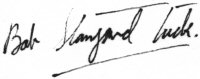 Wing Commander Bob Stanford Tuck DSO DFC** Our estimated value of this signature : £85 Died : 1987 | Wing Commander Bob Stanford Tuck DSO DFC** Bob Stanford Tuck was a flamboyant fighter pilot, his dashing good looks, courage, and success in the air coming to epitomise the young flyers who fought and won the Battle of Britain. To the British public he was a hero in the mould of the knights of old, and today his name is legend. In the early stages of the Battle of Britain Bob fought with 92 Squadron flying Spitfires, quickly becoming one of the leading aces. Promoted to command 257 Squadron, now flying Hurricanes, Bobs dashing style of leadership inspired his pilots to great success. He went on to command the Duxford and Biggin Hill Wings, taking his personal score to 29 air victories before being shot down by ground fire over Northern France in 1942. He died on 5th May 1987. |
 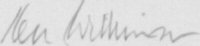 Flying Officer Ken Wilkinson Our estimated value of this signature : £45 Died : 2017 | Flying Officer Ken Wilkinson Battle of Britain pilot flying Hurricanes, he flew Spitfires with 611 Sqn and then 616 Sqn at Kirton-in-Lindsey and 19 Sqn at Fowlmere during 1940 and after a spell instructing returned to operations on Spitfires, with 234 and 165 Squadrons. After spending time with 53, 24 and 10 Operational Training Units, he left the RAF in November 1945 and served in the RAFVR. Ken said : From 1st September 1939 I wrote myself off. I thought, 'you've got no chance' lasting through whatever is going to be. It was quite obvious, in the way the Germans were moving, they were going to make a hell of a war out of it, so I was ready for war. I can remember saying 'we've got to stop this fellow Hitler'. When you think of all the thousands of citizens that were being killed by this absurd bombing. They had to pay for it didn't they. Yes, we lost people. Friends that didn't come back. I don't think we were the sort of people to brood over it, ever. You have to get into an attitude to make sure that you're as cold as a fish. Once someone has failed to return, that's it. Fortune smiled on me and not on some of the others. I can only say that whoever it was who popped off at me, wasn't a very good marksman. It transpired that we were doing something far more important than we thought. As far as we were concerned, it was just that there were some untidy creatures from over the other side of the channel, trying to bomb England and the United Kingdom. And we didn't want them to bomb us. After all, we never asked the Germans to start this nonsense, did we? But they did, and we had to stop them, and we did. It's our country. You die for you country. |
|
Contact Details |
|
Sign Up To Our Newsletter!
This website is owned by Cranston Fine Arts. Torwood House, Torwoodhill Road, Rhu, Helensburgh, Scotland, G848LE Contact: Tel: (+44) (0) 1436 820269. Email: cranstonorders -at- outlook.com |
 |


